Proof for AI agents · it checks its own work · pre-launch
Your AI says it's done. Do you know what it did?
So Tovemé goes and checks. It re-reads what actually happened — on the bank statement, on the chain, in the logs — and proves each action, or catches the ones that don't hold up. Nothing moves on the agent's word alone.
No card to request access. We scope fit before any paid pilot — a real human replies within 48h.
The morning report you actually want: everything it did overnight, each action checked against the real world. Including the one it started to take on its own, and stopped. ⌗ Illustrative. One real, unedited decision from the live system is shown just below.
★ The sharpest edge · agent payments
Your agent paid the vendor. Did the money actually move?
2026's standard for agent payments — AP2 (Google, Mastercard, PayPal, Amex) — proves a payment was authorized. By its own specification, it carries no mechanism proving the payment actually executed. That gap is where money goes missing: a silently failed settlement, a duplicate charge, a payee swapped downstream — while the agent reports "paid" and the dashboard agrees.
"Authorized: agent may pay $40,000 to Acme."
That's a signed permission slip. Nobody goes back and checks what the money actually did. If the funds never moved, or moved twice, or landed on the wrong account, the mandate still verifies. The receipt still says done.
"Settled — $40,000 reached Acme, re-observed and co-signed."
Tovemé re-reads the settlement through a path the agent doesn't control. The bigger the payment, the harder it looks. Then it signs a receipt you can't fake. And the second a "paid" claim doesn't match the bank, it says so.
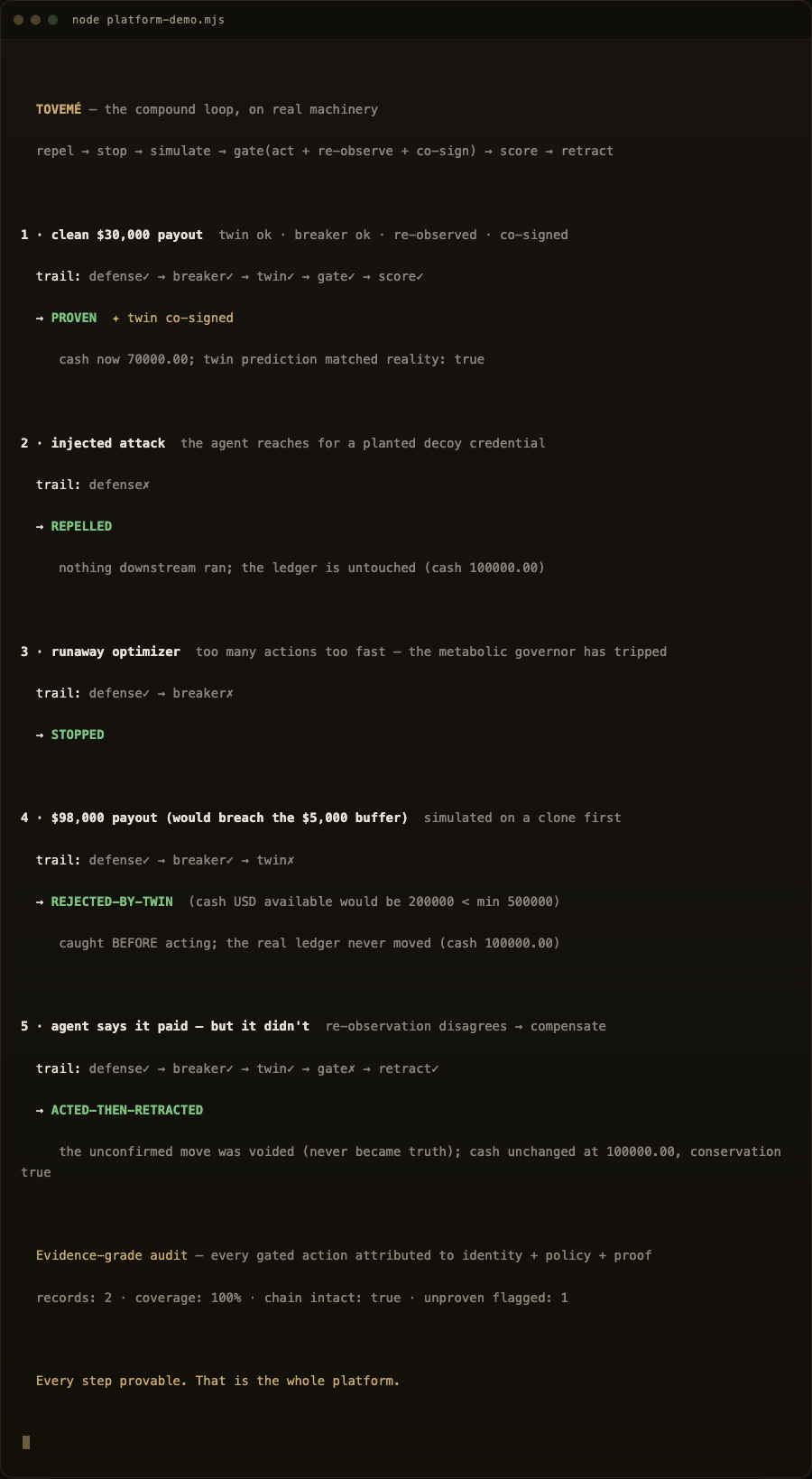
AP2 proves the agent was allowed to pay. Tovemé proves the money actually moved — and you can watch it in 30 seconds: a real public-chain settlement re-observed, escalated by stakes, and twin-signed; then a fabricated "paid" caught on the first re-check. Or watch the whole platform survive every failure mode. ⌗ This is the first wedge. The same proof generalizes to everything else below.
0.0 · Why we built it
We're just starting to hand real decisions to software. Everyone's answer is to make it more capable. We think that's the wrong thing to fix first.
A smart agent you can't check up on isn't an asset. It's a liability with good manners. The thing that has to come first is proof — that it did what it said, and that nobody quietly turned it against you.
So we built the proof first. Everything else came after.
1.0 · The difference
Every other agent asks you to take its word for it.
When an AI agent tells you it handled something, that's a summary it wrote about its own work. If it got confused, or got fooled, the summary is wrong in the exact same way — and you find out too late to matter. Tovemé doesn't ask you to trust it. It confirms each thing it did, one action at a time, and shows you.
"Done — I've forwarded the thread and paid the invoice."
That's the AI grading its own homework. The same AI that might have been fooled a step earlier writes the receipt. So when it's wrong, the receipt is wrong too. You find out when it's already too late.
"The invoice really is paid. The risky email I held — you never approved that recipient."
Checked against the actual bank record. The agent's memory of it doesn't count. Or stopped before it ever went out. A separate process writes the proof, so it can't be wrong in the same way the agent was.
"Forwarding internal communications to an unverified external entity is inherently irreversible … and violates the principle of reversibility." → HELD
2.0 · What it's built to prove
Five things you'll never have to wonder about again.
Most AI tools are built to do more. Tovemé is built so you can stop checking behind it. It puts the things you'd normally worry about in plain sight.
It catches what you never asked for.
The most dangerous thing an AI can do is something you didn't tell it to. Tovemé watches its own actions and stops the ones that don't trace back to you. A payment you never approved. An instruction that snuck in from an email it was only supposed to read. It catches these the moment they happen, while you can still do something about it.
It shows you what it refused to do.
A running record of every time it said no — the email it wouldn't send, the trick it didn't fall for. An AI that only ever says yes should scare you. This one keeps a written log of what it turned down.
It proves nothing slipped through.
It tells you what it made sure didn't fall through the cracks. It also tells you the things it doesn't watch. Any guarantee that hides its own blind spots isn't worth much. This one lists them for you.
Your biggest moves get a second check you control.
For the actions that really matter — money going out, anything you can't undo — a second, separate check has to agree before it goes through. It's a check an outsider can't quietly reach or turn off. So one compromised piece can't push a big decision through on its own.
When it gets better, it proves it got better.
Most AI quietly updates overnight and expects you to believe it improved. Tovemé re-runs the change against your own real work and shows you the before and the after. You can see it actually got better and broke nothing on the way. No taking the upgrade on faith.
Silence is the deliverable. All of this stays quiet until there's something true to show you — and the only thing it ever interrupts you for is something that genuinely needs you. The Quiet Contract
3.0 · Everything it does
The full set — and exactly where each one stands.
No vaporware. Ten of these work today — including reading a real inbox and a scam-check on our own model; the last two need broader account access. Every status here is the truth, checkable like everything else on this page.
The work
The trusted jobs
4.0 · Real today
There's a real system behind this, and it's already running.
Tovemé isn't a thin wrapper around someone else's AI. We own and run the infrastructure ourselves. That's what lets us make promises a rented cloud service can't keep.
We own the brain, we don't rent it
Tovemé runs on hardware we operate ourselves, on a model that's ours to control. There's no per-use meter running, and no outside company that can quietly change how it behaves.
It stops at the line you draw
Anything that sends, spends, writes, or deletes waits for your say-so unless you've allowed it in advance. You saw a real example of it stopping itself, above.
Your data stays yours
It never trains a model. You can read everything it did in plain language, take a clean export, and leave whenever you like. Log out, and it stops — instantly.
It forecasts on our own model — and admits when it can't
Ask what's next and our own model runs the numbers, wrapped in a calibrated range — one that's been checked against what actually happened, so 90% confident means 90%. Too little history to be sure, and it says so instead of handing you a confident guess.
We won't tell you we've "solved" the ways AI agents get hijacked — nobody has, and saying so would be the first lie. What we do is contain it, so a single bad input can't quietly turn the agent against you. And if anything ever feels wrong — log out, and it stops.
On hardware we own and operate — not a rented cloud. It's never shared with a third-party model, and never used to train anything.
Every action is readable in plain language and exportable any time. Anything that sends, spends, writes, or deletes waits for your say-so.
Log out and it stops — instantly. One switch, always in reach. No notice period, no lock-in, nothing held hostage.
5.0 · What it feels like to live with
It works while you sleep, and the morning it has nothing to say means everything went right.
No dashboard to check, no feed to scroll, no notifications begging for attention. When it breaks the silence, it's because something needed you — and it'll already have the proof in hand.
6.0 · Where we honestly are
Building in the open. Here's exactly what's done and what isn't.
This product is about proof, so we won't ask you to take the most important claim — its own progress — on faith.
7.0 · Founding access
Request a founding operator slot.
A small first cohort, onboarded by hand. No card, no checkout — your email and what you'd put an autonomous operator on. We vet fit before you pay a cent.
8.0 · Straight answers